Ben Mears’s Return to Jerusalem’s Lot
'Salem's Lot: A NovelBen Mears’s Return to Jerusalem’s Lot marks the decisive movement from exile into confrontation. Ben does not simply revisit the Maine town where he spent four childhood years; he brings back a life shaped by grief, a boy who refuses to speak about the town, and the unfinished shadow of the Marsten House. His arrival transforms private memory into present action, reopening the place’s buried history just as the town’s apparently secure ordinary life is beginning to fail.
Exile Before the Homecoming
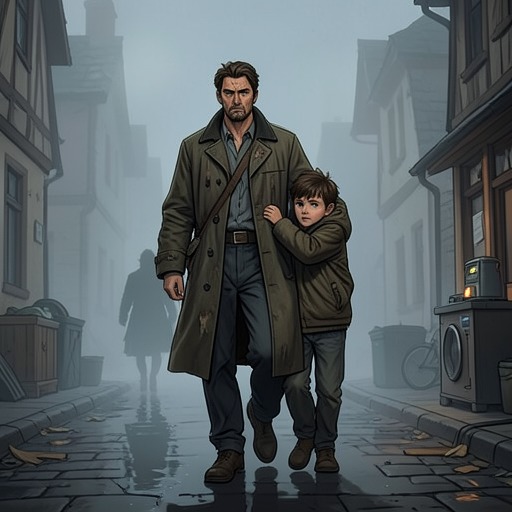
Before returning, Ben has spent years moving through the country with a boy whom almost everyone assumes to be his son. They travel in an old Citroën sedan along a rambling southwest route, avoiding major roads and stopping first in Rhode Island, then Youngstown, Ohio, and finally a small California town near the Mexican border. At each stop Ben works with his hands: in a textile mill, on a tractor assembly line, and at a gas station while repairing small foreign cars with unexpectedly gratifying success. The journey is practical and improvised, but it also functions as an attempt to remain in motion rather than return to the site of injury.
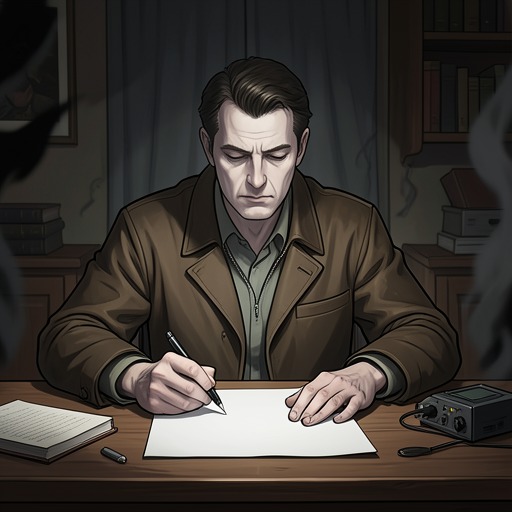
The route never fully breaks Ben’s connection with Jerusalem’s Lot. Wherever they stop, he obtains the Portland Press-Herald and watches for reports about the town and its surrounding area. He has already begun writing again, drafting an outline for a novel in motel rooms and sending it to his agent. A publisher shows interest but refuses to offer an advance; Ben tears up the agent’s letter after explaining to the boy that “Please” and “thank you” are still free, then continues with the book anyway. When Random House eventually offers a $12,000 advance and a likely book-club sale, Ben quits the gas-station job and crosses the border with the boy. The financial success does not resolve the deeper crisis: it gives the return a practical opening without removing its emotional necessity.
The Boy, Memory, and the Decision to Return
The boy’s silence makes the past impossible to treat as settled. He speaks little, remains polite but withdrawn in diners and gas stations, and appears unwilling to let Ben out of his sight. He refuses to discuss Jerusalem’s Lot and will not look at the newspapers Ben leaves in plain view. Even while living adequately in a beach cottage, receiving tutoring, and swimming in the Pacific, he suffers from nightmares in which he screams and throws the blankets onto the floor. Ben recognizes that erasing the town from their lives has not healed him. The Pacific is warmer than the Atlantic and carries no memories, but that very absence makes it a temporary refuge rather than a home.
Ben’s own return is likewise driven by an argument with irrecoverable loss. On September 5, 1975, after passing Portland northbound on the turnpike, he feels an unexpected excitement as the late summer landscape begins to resemble the remembered approach to the Lot. The sight of two boys walking beside the expressway with fishing rods briefly links the present to his childhood. Almost immediately, however, the hope of recovery collapses into the knowledge that twenty-five years have passed and that roads, trees, and places change. His memory also contains the death of Miranda, whose motorcycle accident and the approach of a yellow moving van remain bound to the darkness that overtook his life. The return therefore carries two contradictory impulses: the desire to recover a lost home and the awareness that the loss cannot be undone.
Crossing the Threshold of Jerusalem’s Lot
Ben nearly drives past the exit, considering continuing toward Chamberlain or Lewiston before turning back. The hesitation reveals that the return is a chosen threshold rather than an effortless homecoming. He wonders what home could mean after so much time away, then decides that if he ever had one, it had been this town, even if he had lived there for only four years. He signals, slows the Citroën, and takes the exit toward Route 12, the road that becomes Jointner Avenue closer to town.
At the top of the ramp, Ben sees the peaked, gabled roof of the Marsten House rising beyond the pine and spruce. The town itself is hidden from view; the house alone announces the destination. He brakes so violently that the Citroën shudders, stalls, and stops. The structure exerts a fascination that is at once architectural, emotional, and supernatural. Ben remembers its wet plaster, rotting wallpaper, mice in the walls, plaster dust on the stairs, and the exact fourteen steps leading toward the closed door at the end of the hall. The memory does not appear as a neutral recollection but as a scene he seems to watch from outside himself, with the house enlarging as he approaches it.
He turns away and refuses the immediate confrontation. The house has waited, and that fact is enough for the moment. Ben considers discovering who controls it and perhaps leasing it for himself, imagining the kitchen as a writing room and the front parlor as a place to sleep. Yet he draws a firm boundary: he will not go upstairs unless it becomes necessary. After this brief postponement, he starts the car and drives down the hill into Jerusalem’s Lot. The physical act of entering town thus contains both acceptance and deferral; he returns, but he does not yet cross every interior threshold the return has opened.
The Town He Reenters
Jerusalem’s Lot presents itself as an established community with a long civic history. It was incorporated in 1765, two centuries before celebrating its bicentennial, and its streets form an almost circular settlement organized around the crossing of Brock Street and Jointner Avenue. The town’s geography divides social and emotional spaces: heavily wooded north Jerusalem rises toward the Marsten House; farms and the Royal River occupy the northeast; the more prosperous southeast includes Schoolyard Hill and commuter homes; and the southwest Bend is crowded with trailers, junked cars, beer cans, makeshift yards, and the rough social life of Dell’s. The roads and districts give Ben a recognizable map, but they also reveal a community stratified by landscape, class, and visibility.
The Lot’s public identity is one of safety and continuity. Its residents receive national wars and political crises mainly through television, while local accidents, alcohol, family scandals, and deaths remain the more immediate forms of danger. The town believes that nothing truly terrible can happen in such a pleasant place. That confidence is precisely what Ben’s return begins to test. A town that appears sheltered from national turmoil has its own concealed history, and the Marsten House stands at the point where private violence and supernatural dread enter the ordinary map.
Buried History and the Meaning of Return
The town’s memory preserves the Marsten House as a hereditary horror. Ben and another character fall silent when it is mentioned because the house does not permit the easy nostalgia attached to other childhood recollections. The violence associated with Hubert Marsten and Birdie Marsten occurred before the younger generation was born, yet small-town memory passes it down ceremonially. Later investigation expands that inherited story: four children disappeared between 1928 and 1939 while Hubert and Birdie lived in the house, and none of the children was ever found. The record remains incomplete, but the absences make the house’s history impossible to dismiss as a single old domestic crime.
Jerusalem’s Lot also conceals older layers of violence and secrecy. The town knows that Hubert Marsten killed his wife, but not the circumstances immediately preceding the shooting. Its residents preserve rumors, partial explanations, and family lore while lacking the full truth. A separate, much older record places the settlement’s origins in a Puritan splinter community founded in 1710 by James Boon and links its history to a desecrated church and a forbidden book. Robert Boone’s coded diary dates the final entries to 1789, ending four days before a catastrophic disappearance. These archives do not provide Ben with a clean historical explanation; instead, they establish that the town’s darkness recurs across generations, moving between oral memory, newspapers, private diaries, and physical sites.
The return therefore changes the function of place. Jerusalem’s Lot is no longer only Ben’s childhood home or the setting of an abandoned novel. It becomes the point where memory must become knowledge and knowledge must become action. The later atmosphere confirms that the town is not merely hiding its secrets but participating in their concealment: when supernatural danger spreads, many residents instinctively turn on their lights, retrieve religious symbols, and refuse to look out their windows without understanding the truth. Ben’s arrival precedes this collective disturbance, but it also makes the town legible as a landscape prepared to receive it.
Ben’s homecoming is consequently an inverted return in the heroic sense. He crosses back into the ordinary world not with a healing prize, but with grief, a frightened boy, and the burden of a house that has preserved the past more faithfully than the town has. His decision to drive into Jerusalem’s Lot is the event that reconnects the private wound of Miranda’s death, the boy’s nightmares, the unfinished novel, and the town’s accumulated violence. The return does not restore what was lost. It begins the work of facing what has survived.